
Objects of Process
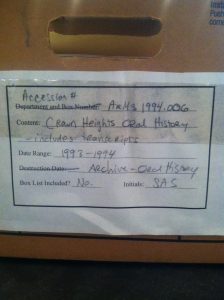
One of my favorite parts of the research process of this project has been reading and listening to oral histories. I spent an afternoon in the Brooklyn Historical Archives looking through community bulletins and reading histories. What initially attracted me in selecting the murals of this neighborhood as subject matter was the embedded layers of process, and that theme continues to emerge no matter the source material.
The founder of the Crown Heights Youth Collective, Richard Green, is an important fixture in the community. In his oral history recording (which will be included in my map), he is speaks to the 30 year history of the organization, specifically to its role in creating a place for kids to be in a neighborhood where they are often deemed suspicious when simply hanging out in the park or on their street, and also to learn useful skills while making things together. I often see him tending to different garden spaces and painting the mural with Kwenci Jones (the artist I refer to in my initial proposal of the project). I have been thinking about how the murals or the gardens demonstrate process, even when they are static or two dimensional. I have been thinking about how to apply this concept in the ways I use URT.
What I mean to say is that the challenges or frustrations I have experienced in identifying what material to include, what to name significant for the story that my map will inevitably tell are in their nature different than they would be if this project were presented through another medium. I continue to realize the many advantages of presenting this material through URT: that it is not locked into a specific order, that it can be reinterpreted and reconstructed, that the arguments continue on.
In The System of Objects Jean Baudrillard challenges the limits of structural analysis of the object, what might we learn from thinking about “…how objects are experienced, what needs other than functional ones they answer, what mental structures are interwoven with—and contradict—their functional structures, or what cultural, infrastructural or transcultural system underpins their directly experienced everydayness.” It is in the everydayness of the Mural or the garden, the process of the object in space and over time that can perhaps teach us differently or reveal something about the relations in a neighborhood that often go overlooked.
I broke down the systems as a sort of brainstorm exercise:
– object of the mural: complicated structure system the limit of the life of the object and the limit of the space in which we dwell
– object of the object: URT representation/interpretation of the mural object
– Everydayness of the system of culture: The function of the object to communicate care.
– Narrative through marking: Intrusion of advertisements due to changing neighborhood; appropriation of culture vs. statement of resource. Site of negotiation and relation.
Although I had wanted to make the map more complicated to try and communicate the complexity of the ‘life of the artifact’, I think that the project will be more effective if I keep it simple and not overload or over burden the idea. This is particularly important to me because of my position in the neighborhood, I would like to continue to tell the story from that viewpoint — a nomadic/rootless contributor/friend.
I will try to wrangle the brainstorm thoughts (and others! 🙂 ) into three arguments:
– Mural as history/resource/system
– Mural as social infrastructure
– Mural as contradiction: proposition through process
While it’s probably best, as you suggest, to keep your map’s technical structure as simple as possible and to avoid overly complicated/abstruse arguments, you can certainly address these more complex Baudrillardian ideas within your arguments.
And I’m glad to hear that you’re finding value in being able to repurpose, remix your data. Every record you post could potentially be integrated into a variety of arguments, and serve myriad purposes within those arguments.